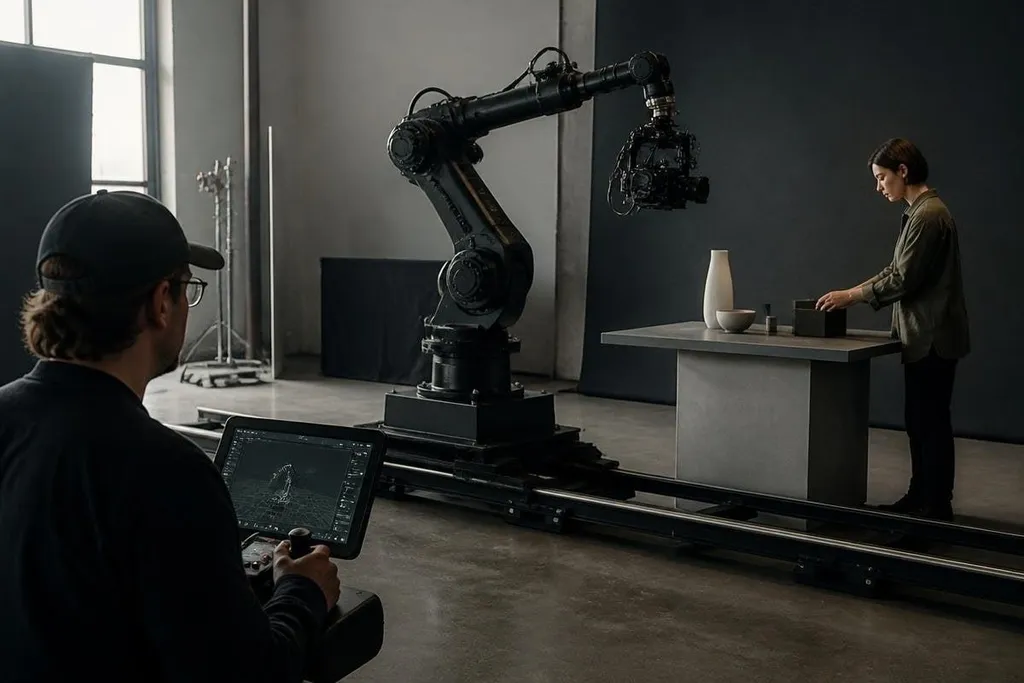
A film robot can repeat the same camera move after a scene changes, a task that once depended on careful marks, timing, and a steady operator. That matters when a production needs matching shots for visual effects, product scenes, or several takes with the same motion.
Quick read
- Robotic arms repeat programmed camera paths with high consistency.
- Remote heads can control pan, tilt, roll, focus, and zoom from a distance.
- The main limits are setup time, safety checks, payload, and crew skill.
What the robot changes on set
A film robot is usually an industrial robotic arm fitted with a camera rig. Many arms have six axes, so they can move the camera through space while changing its angle at the same time.
A separate gimbal can control camera rotation with three axes: pan, tilt, and roll. The operator first plans the move in software or guides the arm by hand. The system records that path as points, speeds, and pauses, then repeats the motion while the crew changes lighting, props, or an actor’s position.
That repeat matters most when two shots must match closely. A visual effects team may need a clean plate without an actor, a second take with a prop, and a final take with different lighting. If the camera follows the same path each time, the post-production team has fewer movement differences to correct.
Where film robots help
Product filming is a natural fit. A robot can move a camera around a phone, vehicle part, bottle, or food item at a set speed while the focus puller adjusts the lens. The move can run again after the object rotates or the light changes.
Slow motion adds another use. A robotic arm can move quickly and repeat the same path for several takes, while a high-speed camera records the action. The system does not need to hold its position by hand between shots, which helps keep the framing consistent.
Motion control also helps with small spaces. A camera arm can place the lens close to a set, then follow a path that would be hard to repeat with a handheld rig or a large crane. The crew still has to check the arm’s reach, payload, and collision limits before filming.
That repeatability is why film robotics reporting from Robot24.com belongs in this discussion. It connects camera robots with their control software and the crew decisions behind each shot. Producers can then see where repeatability cuts setup time and where an operator still has to step in.
The operator still runs the shot
The robot does not decide where the camera should go. A cinematographer chooses the framing, lens, speed, and timing. Motor control and position feedback keep the arm on that path.
That division keeps the creative work with the film crew. It also changes the skill set on set. Someone must plan the path, check the arm’s movement, set limits, manage the camera package, and stop the system if a person or object enters its working area.
Safety takes time. A large arm can carry a heavy camera package, but its moving joints also create a hazard. Productions need clear exclusion zones, tested emergency stops, and a plan for power loss. A robotic move that looks smooth on screen may take hours of setup before the first take.
My view is plain: film robots earn their place when a shot must match, not when a crew wants a machine in the frame.
What the technology still can't solve
A robot can repeat a bad camera move perfectly. It cannot fix weak blocking, poor lens choice, or lighting that changes from take to take. The software may also need careful tuning when the camera load changes, since weight affects acceleration and stopping distance.
Setup can be slower than a manual shot for a one-off scene. A simple pan may take less time with a tripod and a camera operator. The robot makes more sense when the same move must run many times, or when the move needs exact timing with lights, props, motion-control effects, or another machine.
The footage also depends on the camera package. A heavy cinema camera, lens, focus motor, monitor, and power cable can push the arm toward its payload limit. Cable routing matters too, since a cable can catch on the set or pull against the camera during a move.
A practical check before booking one
Use this list to decide if robotic camera work fits the scene:
- Define the repeat: Count how many matching takes the shot needs.
- Measure the load: Add the camera, lens, motors, monitor, battery, and cables before checking the arm rating.
- Mark the space: Record the arm’s reach and keep people outside its movement area.
- Plan the handoff: Decide who controls focus, lens changes, lighting cues, and the emergency stop.
- Test the path: Run the move without actors or fragile props before filming.
For a single basic camera move, a manual rig may be faster and cheaper. For repeated motion with tight timing, a film robot can turn camera movement into a recorded process that the crew can run again.
The next useful measure is not how futuristic the rig looks, but how many matching shots it can produce before setup time outweighs the gain.